Fresh water. What would we do without it? In the Aegean, the cradle of western civilisations, water springs were sacred. To pollute the water was a mortal sin. Ever since the beginning of humanity, people have chosen to settle near life-giving sources of fresh water; with one notable exception: Byznatium. The beginnings of the city later named Constantinople, today’s Istanbul, were rather dry, despite its numerous waterways.
At some point before 330 AD, the then-emperor of the Roman Empire Constantine began to grow a teensy bit uncomfortable about the military threat posed by the Persians. He thought he could do with a capital that was a bit closer to the enemy, so as to keep it in check. He considered several alternatives, including the city of Troy, but finally settled on Byzantium due to its marvellous strategic position: an easily defensible peninsula.
There was only one little problem. There were no springs on the peninsula. Oops.
Constantine and his people were completely unphazed by it all. The Romans were master water engineers, although they certainly wouldn’t have resorted to the modern term to describe their incredible skills in building aqueducts and water cisterns. And so it came to pass: the New Rome was founded and work on the system that supplied fresh water to the city through siege and war, through thick and thin – a system that remained operational for an astonishing 1400 years – began. This post will be split into two instalments and is dedicated to some of the obvious and some not so obvious landmarks from these days, most of which have stood the test of time and continue to amaze us today.
The Cistern of 1001 columns
Most visitors to Istanbul by default head to the most famous of water cisterns: the Basilica Cistern. There is another water cistern, a short walk away, which could be as much as 200 years older than the Basilica Cistern. This is the Cistern of 1001 columns (Turkish: Binbirdirek sarnıcı), which dates back to the 4th century AD and is tucked away into a rather inconspicuous corner of Sultanahmet Square. At the time of writing it was closed for visitors due to restoration works.
The mansion of Fazlı Pasha, an Ottoman vezir in the 1600s, used to sit atop the cistern until it was destroyed by fire. Legend has it that his daughter, the beautiful Gevherli hanım, would lure wealthy men to this very mansion and having done so, would imprison them in the cistern and proceed to confiscate their wealth. Ouch.
When the people of Istanbul stopped depending on the cisterns for their water supply, the latter became obsolete. The Cistern of 1001 columns (which apparently had no more than 224 columns – it is not certain how the name came into being) – was later used to manufacture silk yarn. Eventually, it became… a rubbish tip. During restoration works led by the Mimar Sinan University of Fine Arts, it took seven years to remove 7000 truckloads of rubbish to clear the place out. Surely not the way to treat an ancient monument!
The Aqueduct of Valens
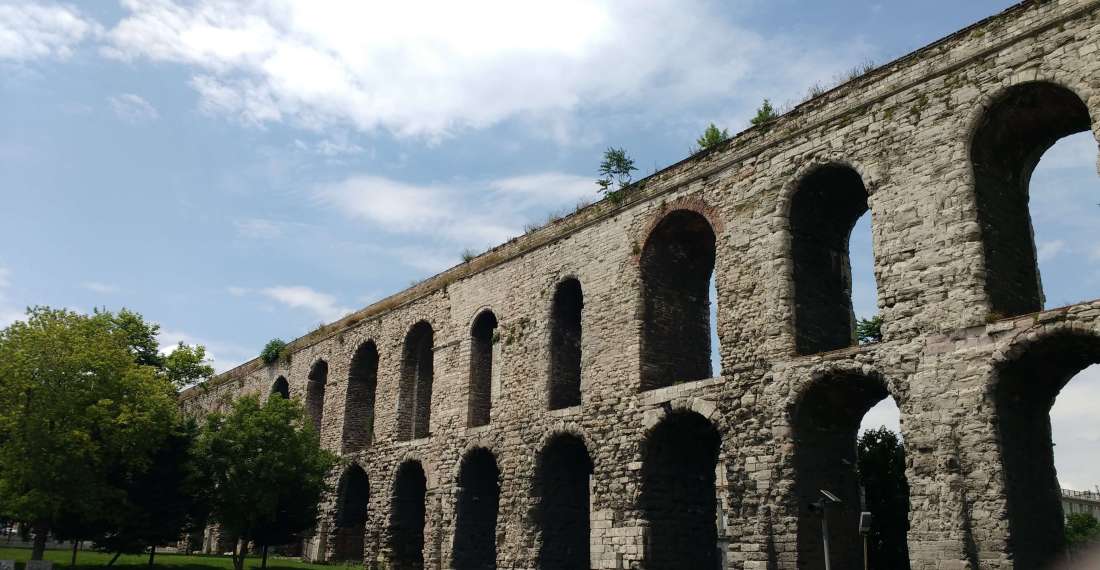
Water cisterns are rather redundant without a supply of water. This was provided by the Aqueduct of Valens, Valens being the name of the emperor who oversaw its completion back in the late 4th century AD. The aqueduct carried fresh water from springs in the Belgrade forest, which lies on the outskirts of current Istanbul. It consisted of a giant complex network of arched bridges, pipes and channels. It had a long-distance line that brought water all the way from Thrace, more than 120 kilometres away! The aqueduct was subsequently expanded and regularly repaired by the Ottomans. Parts of it collapsed as a result of earthquakes; however, a 921-metre section is preserved and stands tall today, reaching 29 meters above ground at its highest point. The aqueduct remained the city’s lifeline, supplying fresh water up until the 1800s, or roughly 1400 years after it was built.
(Digression: Just contrast this to the work of modern plumbers – not all modern plumbers, naturally, but definitely some of them – who’d accidentally drop a brick into a major pipe just for the fun of it, resulting in an expensive call-out on what is usually a Sunday night, within days of allegedly completing work…)
In the second instalment of this post – coming soon:
- The Şerefiye cistern
- The Basilica cistern
- Ottoman water fountains in the city and why many of these have lost their brass or lead taps.
Information from the following sources was used to write this post:
- Prof. John R. Hale, The Great Tours: Greece and Turkey, from Athens to Istanbul
- https://www.kalinti-istanbul.com/item/binbirdirek-sarnici/
- https://www.thebyzantinelegacy.com/valens-aqueduct
- Information on display in front of the Cistern of 1001 columns
- Information on display in front of the Aqueduct of Valens

 Purple Travel Path