Why vist a cemetery? Getting there
I wouldn’t normally choose to go to a cemetery in my spare time, but there was something that sparked my interest in this specific one. The cemetery is mentioned in the book Secret Istanbul by Emre Oktem, to which I have upgraded, having read The rough guide to Istanbul from cover to cover. (Don’t be misled by the name: the latter is actually surprisingly detailed and not rough at all; every time I stumble upon something new, I consult The rough guide, and eight times out of ten, it turns out they have had it covered.)
So, yesterday, I felt that powerful urge to sightsee, but where could I go that was reasonably close and not bursting at the seams with tourists? Having failed to find Haydarpasha last time I set off to visit it, I decided to have another go.
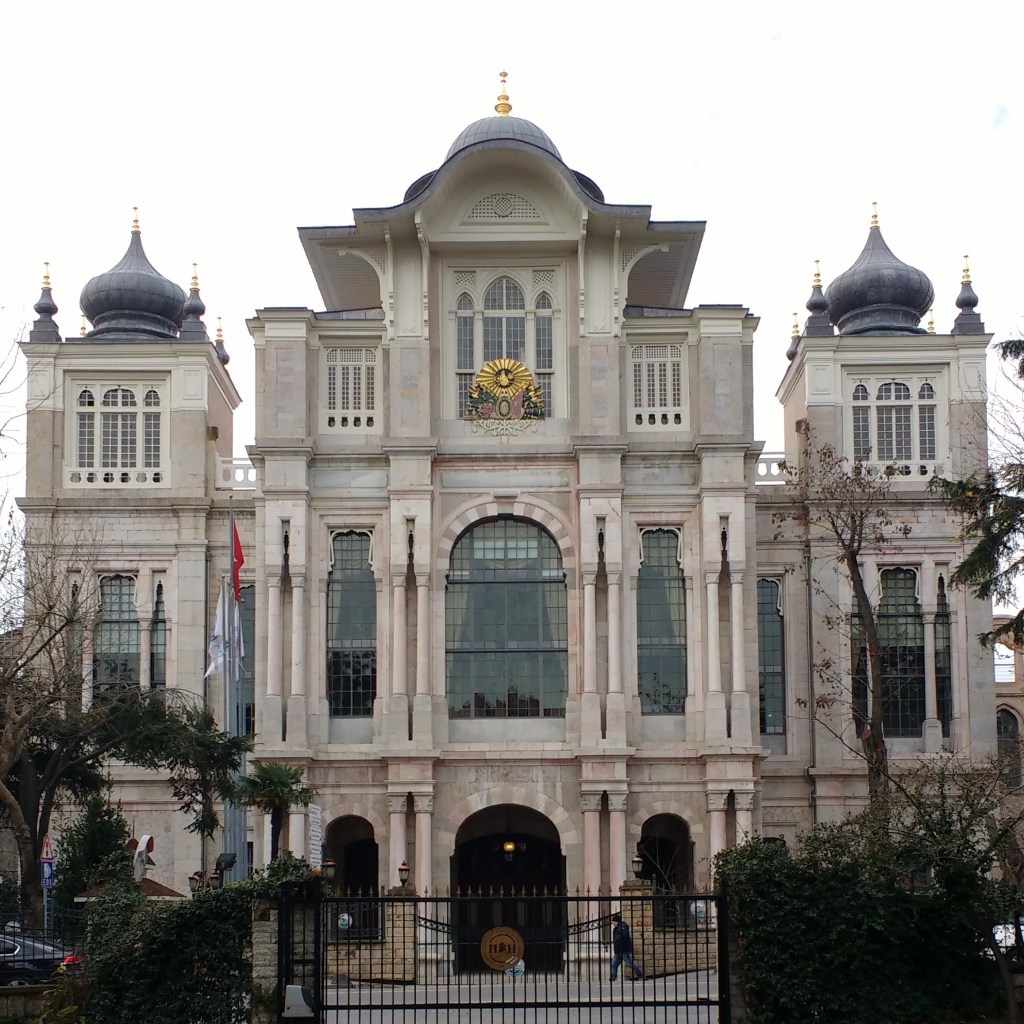
Finding the cemetery took some doing. Google maps is rather unreliable in some parts of Istanbul. It lead me to the locked gate of a construction side. The security guard in the adjacent hospital gave me some directions. If you’re planning to visit, you should walk past the Sultan II Abdulhamid Han hospital (it has a much longer name in Turkish) and turn left just before you reach the rather spectacular building of The Istanbul University Institute of Health Sciences. This building itself is well worth having a look at. Built by Sultan Abdulhamid II and opened in 1903, it is almost otherworldly with its unusual towers and is, no doubt, a fine example of architectural mastery.
At the end of the street, a mossy paved road appeared, with a sign: Commonwealth Cemetery. I was heading in the right direction.
The cemetery sits on the very edge of the land behind the Haydarpasha port, which once upon a time belonged to Suleyman The Magnificent and was donated to the British Government is 1855. The cemetery is maintained by the Commonwealth War Graves Commission.
I walked on. If it weren’t for the sunny weather, the Bosphorus view and the vegetation, I may as well have been transported straight back to Britain. It was as British as any place could get. The lawn was mowed to perfection. There were the typical British no-nonsense notices, which we all know and love, most of which state the obvious in such a polite way, no-one can really object: This is a place of peace and tranquillity. Picnicking is not allowed.
History written on tombstones
The air of reverence was palpable.
One could glimpse into so many lives by reading the writing on the tombstones. The caretaker that had looked after the final resting place of so many for more than 30 years lay among staff surgeons, medical officers, ordinary soldiers who had died of wounds received in the battle of Sevastopol. This cemetery had originally come into being during the Crimean war (1853 – 1856), when troops of the British Empire were stationed in Istanbul, then Constantinople. The writing on some tombstones had been completely erased by the elements; but, where it was still there, it was as if history itself had written. Died at Scutari of fever – read some, using the Anglicised name of the neighbouring district of Uskudar. This is where the British had set up a hospital, the purpose of which was to care for the sick and wounded soldiers. The conditions at the hospital were so desperate, that Thomas Chenery, a British correspondent for The Times, send a report to the newspaper, which was printed on October 12th, 1854:
Not only are there not sufficient surgeons–that, it might be urged, was unavoidable–not only are there no dressers and nurses–that might be a defect of system for which no one is to blame–but what will be said when it is known that there is not even linen to make bandages for the wounded?…
The report caused a public outcry. Florence Nightingale had been trying to make arrangements to lead a nursing team to Scutari and the report contributed to all the necessary permissions being granted.
She arrived in the hospital in November 1854. She is credited with establishing modern nursing for the prominent role she played in relieving the suffering of the wounded soldiers. She would visit them at night to check on them and so she became known as The Lady with the lamp. She arranged for basic things like clean sheets, obtaining medical supplies. She hasn’t been forgotten:
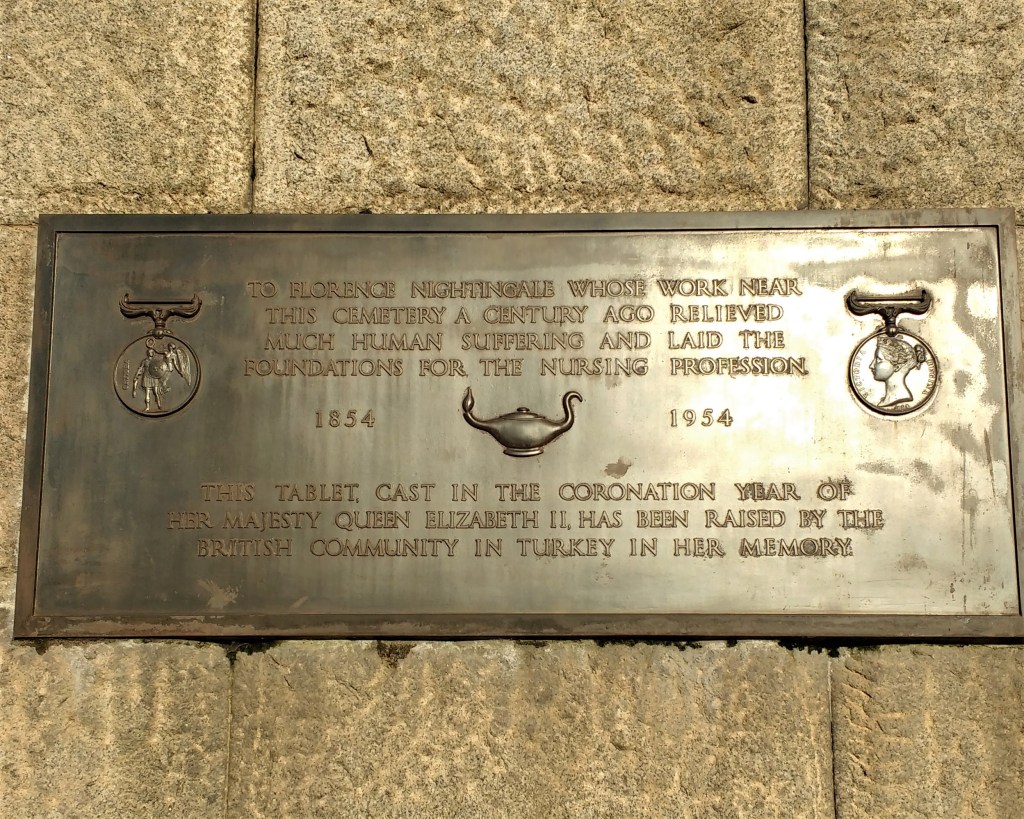
Today, there is a museum dedicated to the work of Florence Nightingale in Uskudar, on the Asian side of Istanbul, not far from the cemetery.
As I continued walking around the cemetery, I saw tombstones of British marines, some as young as 18, erected as a token of respect by their shipmates. I have never really thought about it, but the British Army in the days of the Empire had drafted men from as far afield as India (undivided India, back then) and they had also had the misfortune to be killed in action. A part of the cemetery is dedicated to them.
Civilians were also buried in the cemetery. Underneath some typical British names one can read: Born at Tripoli (I was perplexed for the tiniest of moments until I remembered, of course, that Tripoli had also been part of the Empire); Born at Smyrna. How and why would a British national find themselves all the way in Smyrna, present-day Izmir? Died at Pera. Pera was once the area known as today’s Beyoglu, the lively surroundings of Taksim Square. I winced at the preposition – at – but it’s reasonably to assume that language, too, changes; not only people. I found it interesting that the once-priest of the British church in the nearby area of Moda was also buried there. The church is still standing and is in immaculate condition, no doubt due to a recent renovation.
Moda was were Brits, who, for one reason or another, found themselves in Istanbul, chose to live once upon a time (as in, in the beginning of the 20th century). There were graves of distinguished diplomates, including the once-British Consul to Crete.
In a prominent place in the middle of the cemetery, there is a monument erected by Queen Victoria (and her people, says the writing) to commemorate the lives of so many who have died fighting for their country. There is writing on the monument in (what I assume is) old-style Turkish – Ottoman script, English, Italian and French. Talk of unfortunate coincidences: these were the language of the allied forces that occupied Istanbul only some 25 years after the monument was erected, at the end of the First World War.

The temporary nature of all being(s)
There is a saying in Polish that I find hard to translate, but that captures perfectly the temporary nature of all our lives. Nie było nas, był las. Nie będzie nas i będzie las. We weren’t here; the forest was. We won’t be here; the forest will still be here. So many people have lived, breathed, dreamed, loved and we wouldn’t even know they ever existed, were it not for places like the Haydarpasha British Cemetery. If you are ever in Istanbul and happen to take the ferry to the Asian district of Kadikoy, look to your left as the ferry approaches and you’ll see some greenery behind the Haydarpasha port. That’s the cemetery. Preserving the memory of those who had passed away is essential. And, as we think about them, we become more appreciative of our own lives and of what we have today.

 Purple Travel Path
Great post😀
LikeLike